
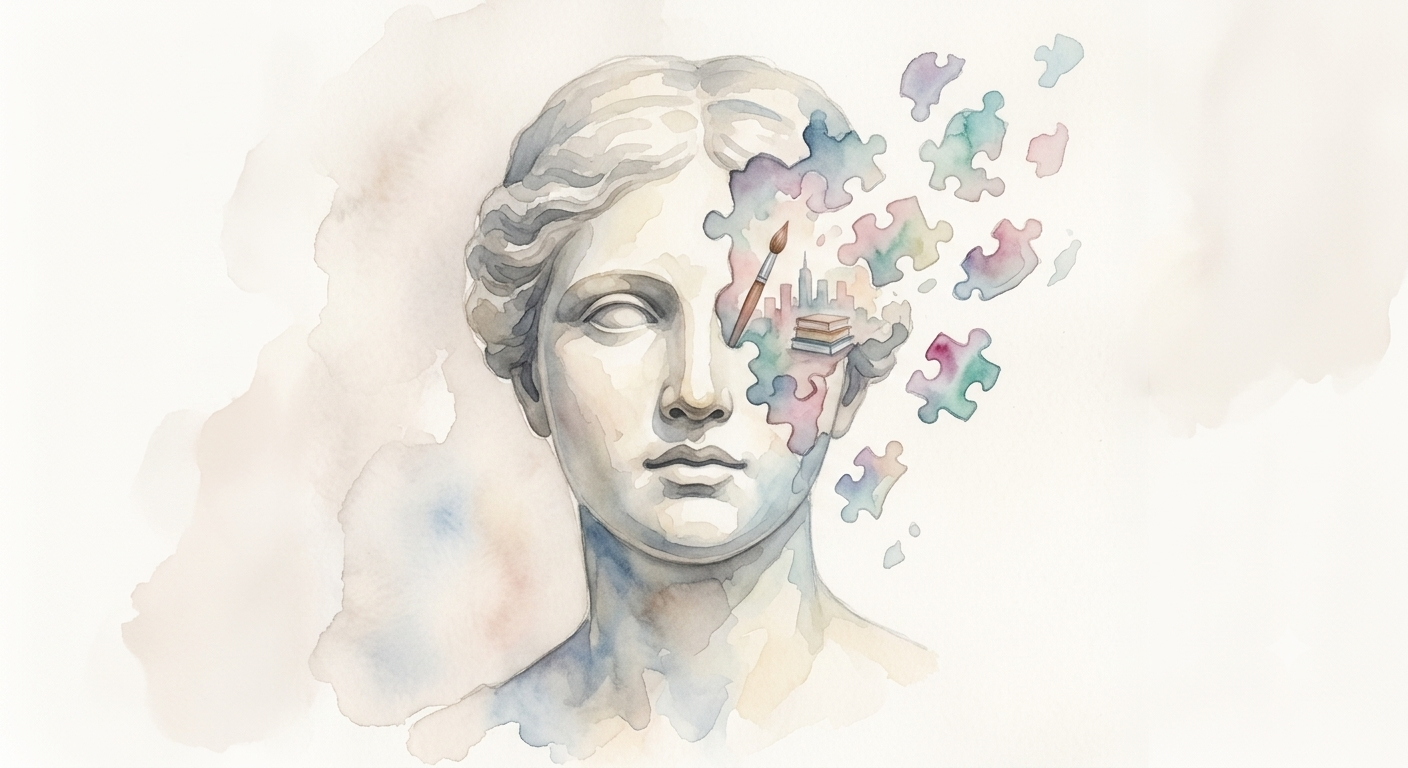
Caregiving parents rarely notice they are disappearing while it is happening. The process does not feel like loss. It feels like adaptation — reasonable adjustments to an unreasonable situation. You are needed somewhere else at all times, so you stop making plans for yourself, because plans keep falling apart. You stop talking about yourself in conversations because there is always something more pressing to cover. You stop doing the thing you used to love doing, because there is no longer time, and then because there is no longer the version of you who even wants to do it.
At some point you look in the mirror and realize you have not been the subject of your own life for a while now, but you cannot even say exactly when that started and at what point your life became the background to someone else’s.
Role engulfment
Researchers first formally described this in the early 1990s, studying family caregivers of people with Alzheimer’s disease. They called it role engulfment — the caregiving role expanding until it consumes the person inside it, until the caregiver and the role become indistinguishable. The person stops having an identity that exists outside what they do for someone else. Personal needs, interests, relationships, a sense of future — all of it gets progressively subordinated to caregiving until there is very little of the original person left.
What the research found is that role engulfment is directly associated with lower self-esteem, reduced sense of mastery over your own life, and significantly greater depressive symptoms. The more completely caregiving absorbs a person, the worse their psychological outcomes. Loss of self in long-term caregiving is a measurable clinical variable, and its consequences are well documented.
Why caregiving parents are particularly at risk
Identity is not something you have. It is something you practice. The parts of yourself that exist outside caregiving need regular engagement to stay alive as parts of how you experience yourself.
A friendship that never gets time stops feeling like yours. An interest that has not been practiced in years becomes something you used to have. The self that existed before the diagnosis does not disappear because something dramatic happened. It disappears because it keeps getting moved to later, and later keeps arriving full.
Research on which caregivers are most vulnerable to role engulfment points consistently to those with few roles or relationships outside caregiving. A parent whose daily life has been organized entirely around a child with complex needs for years on end fits that description with almost no exceptions.
The cultural narrative around caregiving parents makes the situation significantly worse. Total self-sacrifice gets valorized in this context. The parent who never puts her own needs first is held up as the standard, which means the parent who is losing herself is not just losing herself. She is also receiving constant messaging that losing herself is what devotion looks like. The guilt about whatever self remains becomes another pressure on top of the disappearance.
What it does to your sense of future
The most underestimated consequence of role engulfment is what it does to a person’s relationship with her own future. Making a plan requires a self to make it for. When the self has been organized around someone else’s needs for long enough, the question of what you want — in a year, when things change, eventually — stops functioning as a real question. Caregiving parents in long-term high-demand situations frequently describe losing the capacity to make personal plans or even to imagine what they would choose if they had the option. This is not depression, though depression often accompanies it.
Self-esteem in this context degrades in a specific way. It is not that caregiving parents feel bad about themselves in general. It is that the sources of self-worth that existed outside caregiving — professional identity, relationships, the sense of being good at things that belong to them personally — have gone quiet from disuse. What remains is performance inside the caregiving role, which is both relentless and largely invisible to the people around them.
What the research says about the recovery
The research on role engulfment points to one thing that reverses it: maintaining any role or activity outside caregiving, even minimally.
Something practiced consistently enough that you keep showing up as a person rather than only as a caregiver. Studies find that caregivers who hold even one active role outside caregiving show significantly better psychological outcomes than those who hold none. The size of the role matters less than its consistency.
The cultural messaging around complete self-sacrifice has been absorbed so completely that wanting something for yourself can feel like taking it from your child. The research says that is not what is happening. Caregivers who hold onto a sense of self outside the caregiving role sustain better over time, maintain more stability under sustained pressure, and are better able to keep going in a role that has no defined end point.
That is easier to understand than to act on, and nobody is pretending otherwise. The guilt that makes it feel impossible was put there by a cultural story about what caregiving parents should be willing to give up, and the list is endless.
The research tells a different story, and knowing which one is accurate changes what you are working against.
I have written a letter that I am sending out on Sunday, that accompanies this piece and is my personal account of what identity loss actually looks like in my life — the slow disappearance that one can only see with time and when it has already happened.
If you’d like the personal stories and the behind-the-scenes, including the companion letter mentioned above, they live in my weekly emails.
If you want the practical side of this — what the research identifies as the way back — it is here: Radical Self-Prioritization: What It Actually Looks Like in a Caregiving Parent’s Life.
Related from the blogYou’re not who you were before · Feeling detached isn’t burnout — it’s dissociation