
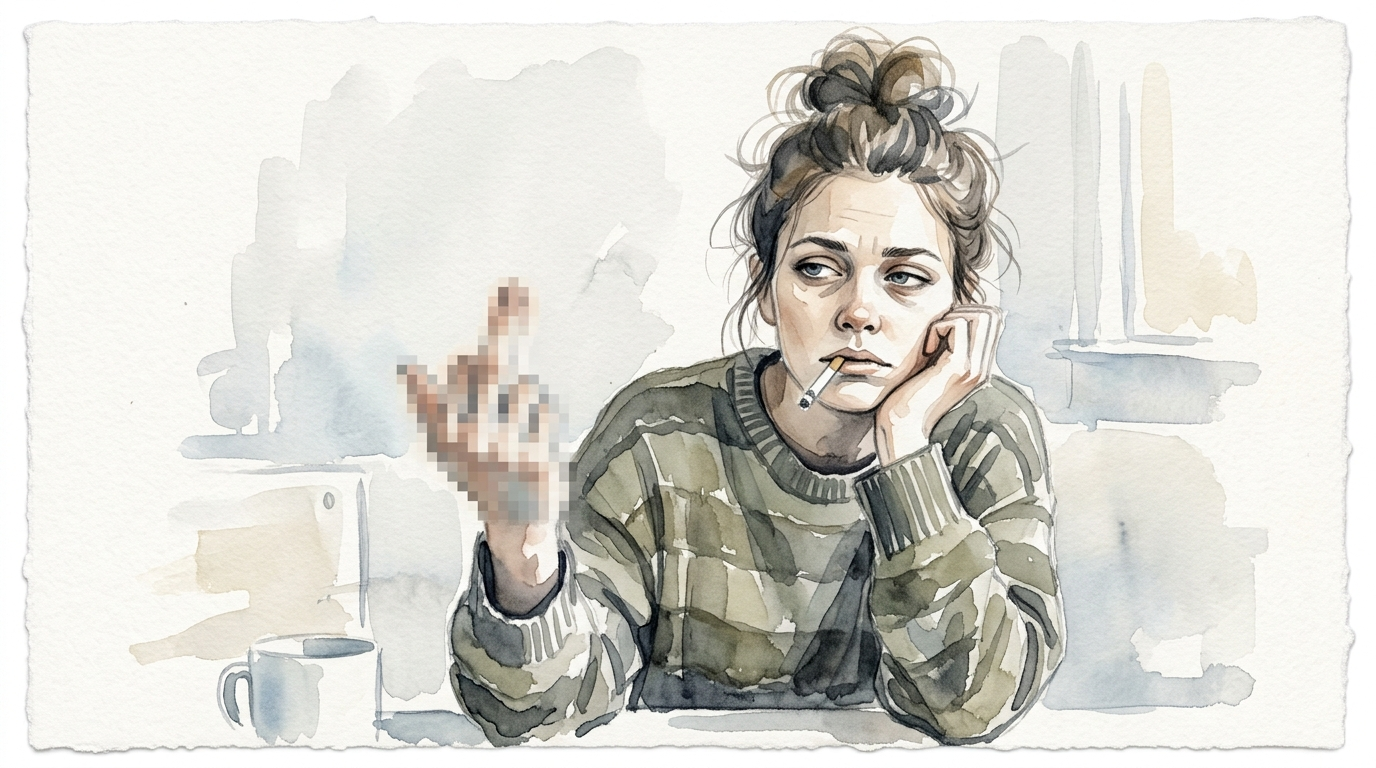
And why I think toxic positivity deserves a middle finger.
A creator I respect, a mom raising a baby with serious medical needs, recently posted a video where she said, “I do not want to be remembered as a sad mom.”
I understand why she said it, and I’d want that too, at least some times. But it landed like a rock in my garden, because I am a sad mom. I have been for years. And I write for parents who are tired and sad, which in this world is a lot.
I wish I weren’t a sad mom. But I’ve come to believe that for many of us, attitude is not a choice.
My parenthood started with being homeless. That word makes people picture a tent under a bridge, and that wasn’t us. We were the kind of homeless you don’t see. We couldn’t afford rent, so for two years we lived in one room in a friend’s house. Lots of families live like this, in a friend’s spare room, on a cousin’s couch, in a relative’s basement, and they rarely get counted as homeless because there’s a roof over their heads. We just moved to Colorado and my husband didn’t have an employment, we were on food stamps because without them we would have physically starved, and we had zero family support.
Then postpartum depression annihilated me. I don’t mean I was sad because my life was hard and I was emotional about it. My brain was not functioning. The pregnancies wrecked my hormones so badly that after three of them, my body went into perimenopause ten years before it was supposed to.
Being broke was the part I could explain to people. The hardest part was the part I couldn’t: trying to make medical decisions for my child with a brain that couldn’t hold a thought, living in a body that had turned against me, and having no one to hand the baby to. Every mom in this world has her own version of that list. For some it’s a partner who checked out, or no partner at all. For some it’s a diagnosis of their own, years without sleeping through the night, or grieving the child they thought they’d have while caring for the one they have. Most of us are carrying several at once.
Science backs this up, even where finances, as most obvious, aren’t the issue.
Norway has universal healthcare, generous parental leave, and one of the strongest safety nets in the world. Researchers there followed more than 1.5 million mothers for over a decade and found that mothers of children with disabilities were still more likely to be diagnosed with depression, anxiety, sleep disorders, and chronic pain than other mothers. That held true even after accounting for their health before the child was born. In Australia, a survey of mothers of disabled children found that 44% had clinically significant depression, compared with about 5% of Australian women overall. This isn’t just a group of women with “bad attitudes”.
Here I have to be honest about myself. The people we see online are usually the ones who have the resources to be there, and I’m one of them now. I didn’t start writing or posting during the years in that one room in a stranger’s house. I couldn’t have. I only showed up online after my husband found a stable income, we moved across the world 2 times chasing climate where our kids would thrive, and we were finally able to afford some support. With that support I healed… hard. In the past year and a half, first time in last decade went to see a doctor for my own needs, prioritized sleep and some semblance of identity outside motherhood. Only after all that I was able to sit down and write a book on self-advocacy and true statistics of what special needs parenthood does to people.
Filming, writing, and showing up for an audience take time, energy, and a mind that’s working, and for years I had none of those. So when you see me here, you’re seeing someone who got a little ground under her feet. You didn’t see me before, and that’s exactly my point.
So the version of special needs parenting on our phones tends to come from families with something underneath them: a partner who shows up, grandparents who babysit, a body and brain still holding together. I believe there are far more moms working at gas stations, at Walmart, and driving Amazon delivery just to make ends meet for their special needs kids than there are moms building lifestyle brands in this niche. And there are moms who can’t get off the couch today, moms sitting in a hospital room for the third week in a row, and moms whose husbands left after the diagnosis. Those moms don’t post. I know, because for years I was one of them.
When the only parents we see are the ones with support, it shapes what we think we’re supposed to feel. Expecting help and being hurt when it doesn’t come is a real pain. Many of us never had anyone to expect it from. Hearing “cheer up” from that position, even indirectly, feels like being asked to show a recovery we were never given the means to make.
Everyone’s cheerfulness is measured from their own baseline. If your baseline is a house, a partner who stays, a mother who picks up the phone, and a church that shows up with dinner, a hard year lands differently. Some of us started from a borrowed room, a brain that wasn’t working, and no one to call. Some started in a house where we weren’t safe. And one year into this life is a different place from ten or twenty years in.
I don’t think the women sharing their cheerful hearts are lying about their lives, and for many of them that cheer is part of their faith, which I respect. Good for them, truly. But mothers are already expected to serve with our hands and our time, and somewhere along the way we also started being expected to serve with our faces. If you can’t find the “attitude of gratitude” right now and you feel guilty about it, let me tell you, you don’t have to. Being honest with yourself counts for something too. This is for the moms who are done performing.
If you’re a sad mom too, you don’t owe anyone a happier version of yourself. You’re allowed to be remembered as you actually were: tired, sad, and there for your kids anyway.
If you’d like my letters in your inbox, and to be one of the first to read them, you can join here.
Related from the blogHow I missed my own recovery · Radical Self-Prioritization · On narcissistic mothers & postpartum depression