
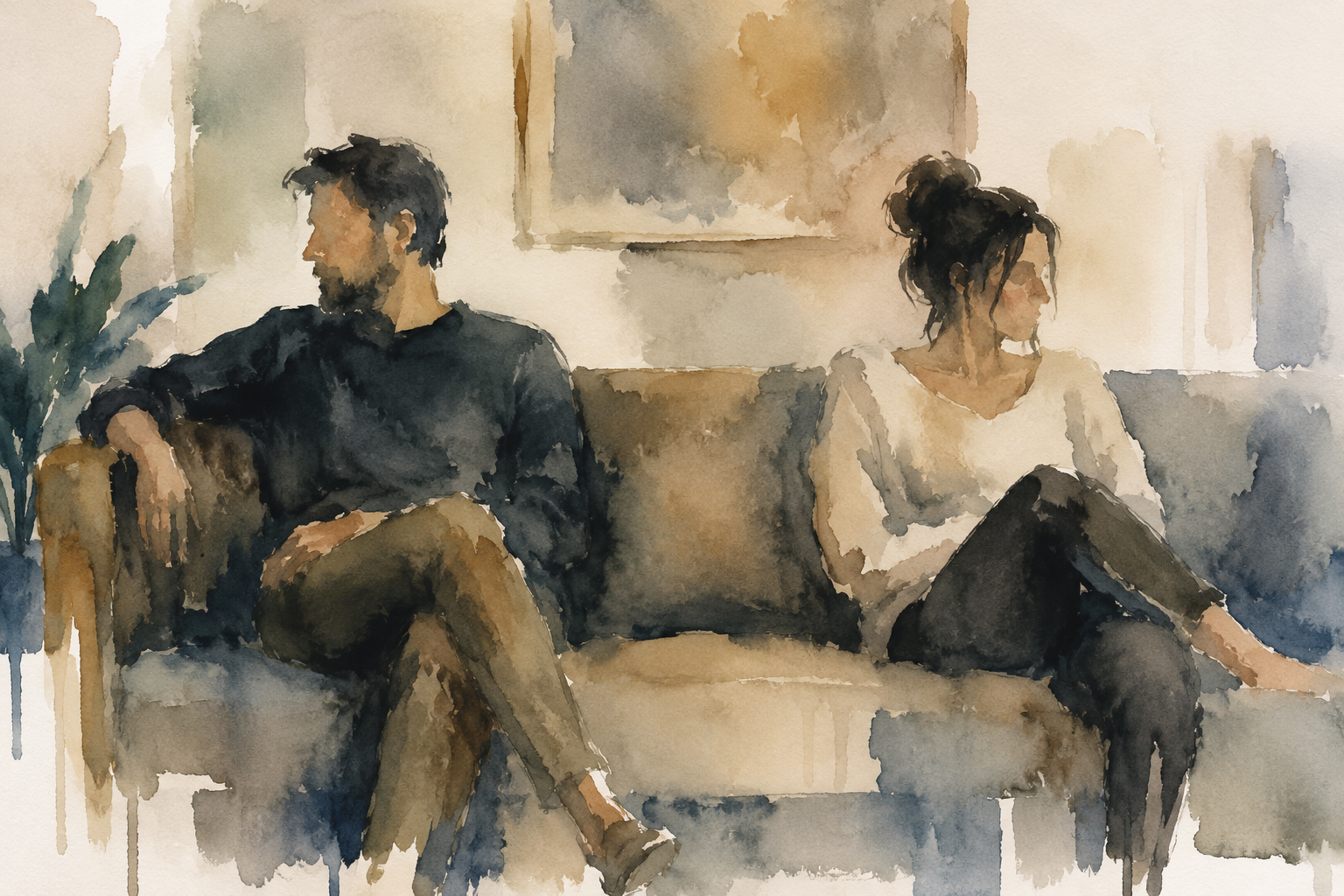
My husband and I had been told for years that for the special needs caregivers divorce is next to unavoidable. Ninety-six percent of marriages like ours fail. Then ninety. Then eighty. The number kept changing depending on who was saying it, which should have told me much sooner that nobody actually had one.
One study compared us with parents of children who are not disabled. About one in four of us divorced, against one in seven of them. A second study found no difference between the two groups at all. No study has ever found anything close to eighty percent.
We stayed, and I would like to tell you love is what did it, but the truth is closer to this: leaving is an enormous amount of work and neither of us had the energy to organize it.
We still have talked about divorce more than once, never during a fight, always as if it was a math problem we were solving together.
The logic runs like this. If we split up, and if each of us were lucky enough to find somebody else, our children would end up with four adults involved in their care instead of two. Four people to cover the appointments and the nights, two households, which would mean each of us was occasionally off duty, something neither of us has been in years. In comparison to that was our marriage, which is the two of us in the same swamp doing the same routines that nobody rewards and nobody notices, until we are old. Laid out that way, divorce looked like not the worst option, and we both knew it.
What I actually want to write about is what I got wrong during those years, because I have not said it out loud anywhere and it has been sitting on me for a while.
For a long time I believed I was doing all of this by myself, that he was not contributing, and I built an entire grievance out of that belief and carried it around for years. It was not true. He was taking the children to their appointments. He flew to Serbia with our son to have his brain imaging done. He was earning every dollar the five of us lived on, and he was doing it while his wife was too far gone to notice.
I could not see any of it, and I want to be precise about why, because “I was ungrateful” is the easy version and it is also wrong. I had not slept properly in years. My nervous system had stopped registering good input of any kind, from anyone, about anything. The help was in the house, in front of me, and I did not have the ability to take it in.
That is the part I would most want another woman in this to hear. You cannot assess your marriage from inside sleep deprivation and nervous system dysregulation, because the thing you are assessing it with does not work.
Nothing improved because we “worked on our marriage”. We never did that. What happened is a bit of luck and a whole lot of life reorganizing. The children started school after we moved to Central America, and I began sleeping, and for the first time in years some portion of the day belonged to me. Only from there was I able to look at my husband and see an actual person instead of a man who was failing to do enough.
The other half of it is his. He had been carrying serious anxiety the whole time, and from the outside that looked like distance, like a man who had stopped caring very much. The research I was doing for this project is what taught me the word anhedonia, and I brought it up in a conversation and shared with him, and he recognized himself in it. He accepted that his nervous system needed medication and he went and got it.
So both of us got care and treatment we needed, separately, for our own reasons, and the marriage improved as a result.
Which brings me to the thing I actually believe, and it is the reason I am writing this instead of something more like “5 practical steps”.
Nearly every piece of advice given to couples like us assumes two functioning adults with a communication problem. “Have a date night, express appreciation, divide the labour more fairly.” All of it was written for people whose bodies are working. If you are where I was, you can execute that entire list and feel absolutely nothing, and then conclude your marriage is finished, when what is actually true is that you have lost the capacity to feel anything at all, about him or even about yourself.
So the actual practical part of this letter is not about your marriage.
Start with sleep, and I do not mean the question of whether you are tired. I mean whether you have had a single real stretch of sleep in the past several years, and what your judgment of your husband has been made out of during all the years you did not.
And if there is anything at all in your setup that can be changed to buy you sleep and maybe an hour a day that belongs to you, do that before you do anything else. It is obviously less romantic than “working on your relationship”. But it is also the thing that actually works.
Couples like us get told to talk it out. Find what went wrong, name the resentments, have the long difficult conversations. That takes energy most of us do not have, and it is aimed at the wrong problem. It makes you commiserate and dwell in everything that went wrong over the years. It does not give you an actual way out.
If you are keeping score right now, I want to say something about it. At my worst, I could recall every single thing my husband had not done. I could not recall one thing he had. And it was not for the lack of his doing. Noticing what somebody does for you takes effort, and being annoyed with them takes none at all. So the annoyance stayed and the noticing did not, and after a few years of that I had a very detailed and completely inaccurate picture of the man I was married to.
Since the initial diagnoses 8 years ago, my children have been evaluated more times than I can count. Assessed, screened, scored, observed, measured, written up. In all of that, no one screened me for trauma, and no one asked my husband a single question about his own state. The entire apparatus that assembles around a disabled child has no part for the two adults holding the household up, and it is not going to grow one.
So that job is yours, and it is the most useful thing I know how to hand you. Get yourself assessed, by somebody with knowledge, for what bothers you the most, through whatever door you can actually get through where you live. May that be an act of radical self-prioritization. You are not failing at your marriage. Two unscreened people are running an operation that would take a staff, but that is, again, a different problem.
I wrote the practical version of all this out in full, nine things that actually fit inside a caregiving life rather than the usual advice about bath bombs and date nights:
The version of self-care that gets sold to caregiving parents is almost always a variation of the same thing: take care of yourself so you can take care of them. Rest so you can give more. Refill your cup so you can keep pouring.
If you’d like more of the personal letters like this one, they go out through my Substack.
Related from the blogWhen caregiving takes your name · Feeling detached isn’t burnout — it’s dissociation